
Dr. Arif Akhtar
Senior Urologist
Hello! 👋 Welcome to Dr. Arif Akhtar. He is a Gurugram-based urologist specializing in robotic urology, uro-oncology, and kidney transplantation.
Just now
Two questions sit behind almost every robotic prostatectomy consultation: will this remove the cancer completely, and what will be left afterward — for continence, for sexual function, for daily life. Dr. Arif Akhtar performs robotic radical prostatectomy in Gurugram with both questions treated as equally important, not one traded quietly for the other. This page walks through how the procedure works, how nerve-sparing decisions get made, and what recovery genuinely looks like.
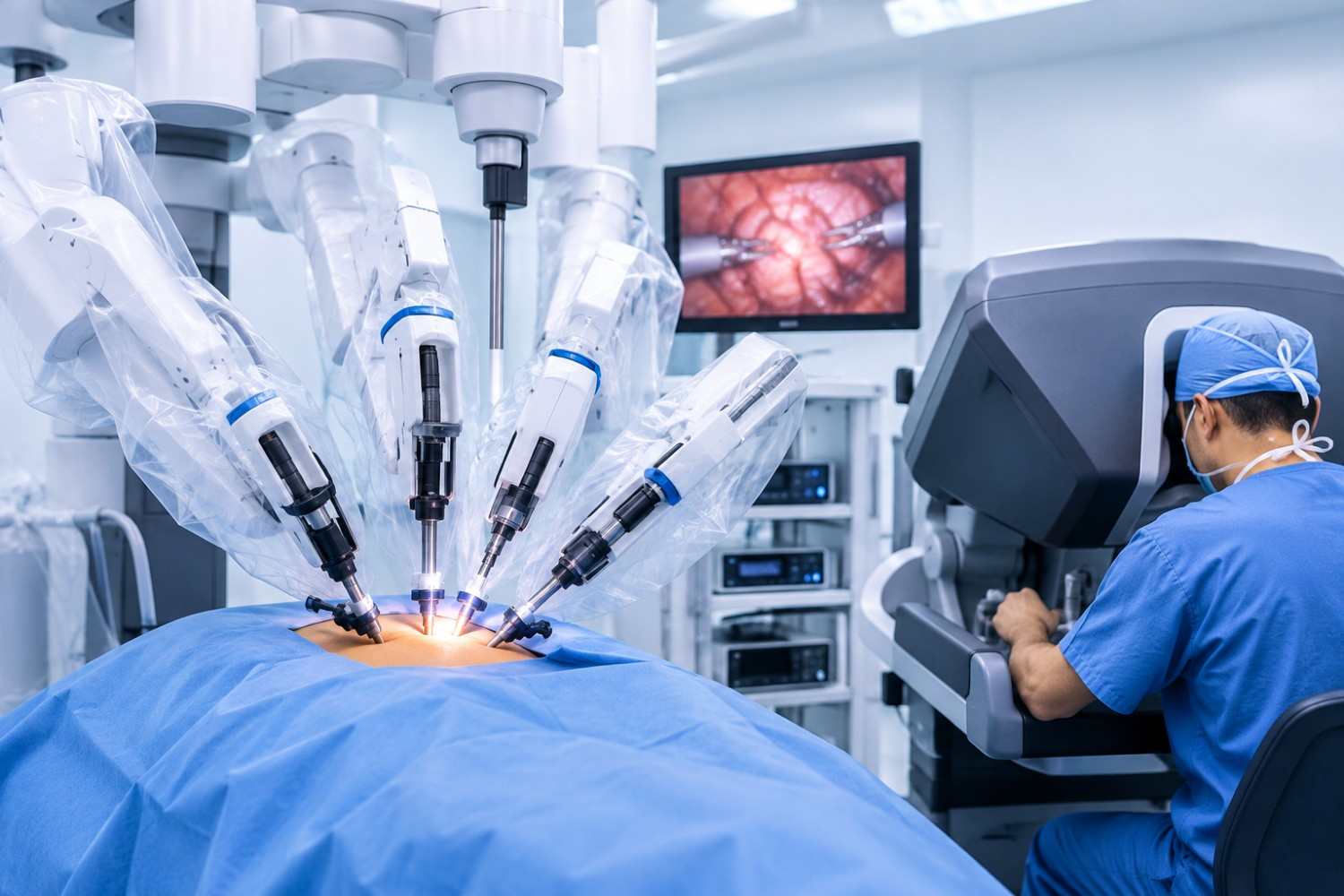
Robotic prostatectomy removes the entire prostate gland through several small incisions, using a robotic system that gives the surgeon 3D magnified vision and wristed instruments with a wider range of motion than the human hand. This matters most around the prostate specifically because the delicate neurovascular bundles — the nerve structures responsible for erectile function — run directly along its surface. The added precision compared with open or standard laparoscopic surgery can meaningfully help with the fine dissection needed to spare these nerves where it is oncologically safe to do so.
Robotic prostatectomy is generally suitable for localized and select locally advanced prostate cancer. Candidacy depends on your Gleason score, PSA level, clinical stage and overall fitness for surgery. For very advanced or metastatic disease, other treatment approaches are usually more appropriate, and this is discussed openly rather than surgery being presented as the default for every stage.
Discuss Your Treatment OptionsNerve-sparing decisions are individualized to balance cancer control with the preservation of erectile function. The approach is determined by the location and extent of the prostate cancer, together with your imaging and biopsy findings.
The neurovascular bundles run close enough to the prostate that preserving them can sometimes risk leaving cancer cells behind, particularly if the cancer has grown close to or through the prostate capsule on that side. Before surgery, imaging and biopsy findings are used to estimate the risk of extracapsular extension on each side of the prostate. Nerve-sparing is offered only on the side where that risk is considered sufficiently low.
Where the cancer risk profile allows it on both sides, bilateral nerve-sparing preserves both nerve bundles and is associated with better potency recovery outcomes in published surgical literature. Where only one side is safe to spare, unilateral nerve-sparing can still support recovery compared with sparing neither side. The decision is based on your specific imaging and biopsy findings.
For higher-risk or more locally advanced disease, wider tissue removal — including part or all of the nearby nerve structures — may be necessary to achieve adequate cancer control. In these cases, complete cancer removal takes priority, and this trade-off is explained clearly before surgery.
Your MRI, biopsy results, including Gleason grade, and PSA level are reviewed together to finalise surgical planning, including the nerve-sparing approach appropriate for your specific cancer.
Working through several small incisions, the surgeon uses robotic instruments and a 3D camera to carefully separate the prostate from the bladder neck and the urethra, dissecting along the planned nerve-sparing plane, then removes the prostate gland completely. The bladder neck is then reconnected directly to the urethra, a step called the vesicourethral anastomosis, and a catheter is placed to support healing of this connection.
For patients at higher risk of cancer spread to nearby lymph nodes, a pelvic lymph node dissection may be performed during the same procedure to check for and remove any affected nodes. This also helps establish accurate staging and informs any further treatment planning.
Schedule a ConsultationUnderstanding the Potential Benefits and Surgical Risks
Robotic prostatectomy is a minimally invasive approach to removing the prostate for selected patients with prostate cancer. Compared with open surgery, it generally involves smaller incisions and may support less blood loss, a shorter hospital stay and an earlier return to daily activities. However, like any major surgery, it carries potential risks that should be discussed in the context of your cancer, treatment plan and overall health.
Robotic prostatectomy is performed through several small incisions rather than one larger open incision. This minimally invasive approach is generally associated with less blood loss during surgery compared with open prostatectomy.
Many patients undergoing robotic prostatectomy can leave the hospital sooner than patients undergoing traditional open surgery, depending on their recovery and individual clinical circumstances.
The robotic system provides magnified 3D visualisation and articulated instruments, supporting detailed dissection around the prostate and neurovascular bundles when nerve-sparing is appropriate.
The minimally invasive nature of robotic surgery may allow patients to resume normal daily activities sooner, although recovery time varies depending on individual health, surgical findings and the nature of the procedure.
Urinary leakage is common during the early recovery period after prostatectomy and usually improves with time and pelvic floor rehabilitation. In some patients, however, longer-lasting incontinence can occur.
Erectile dysfunction can occur after prostatectomy, particularly when nerve-sparing is not fully possible because of the location or extent of the cancer. Recovery varies between individuals and may take time.
As with any surgical procedure, robotic prostatectomy carries a risk of bleeding or infection. Your surgical team takes measures before, during and after surgery to minimise these complications and monitors your recovery closely.
A positive surgical margin means cancer cells are found at the edge of the removed tissue. If this occurs, additional monitoring or further treatment may be recommended depending on the pathology findings and postoperative PSA results.
Rarely, surgery can result in injury to nearby structures. The exact risk depends on individual anatomy, previous treatments and the extent of the cancer. These potential complications are discussed as part of informed consent before surgery.

Dr. Arif Akhtar's robotic surgery training includes the Vattikuti Travelling Scholarship, and his uro-oncology practice in Gurugram includes robotic radical prostatectomy alongside kidney and bladder cancer surgery. His approach to nerve-sparing follows the principle described above — individualised to each patient's imaging and risk profile, not a single default technique applied to everyone. Exact current qualifications, hospital affiliation and case experience should be published exactly as verified by the doctor and kept consistent with the About, Prostate Cancer and Robotic Urology pages. [VERIFY WITH DOCTOR]
Hospital stay after robotic prostatectomy is generally a few days. A catheter remains in place for a period after discharge — typically one to two weeks — to support healing of the bladder-to-urethra connection, and is removed at a follow-up visit once healing is confirmed.
Some degree of urinary leakage is common in the weeks immediately after catheter removal, and this generally improves progressively over the following months, often supported by pelvic floor exercises started early in recovery. Most men see substantial improvement within the first year, though the exact pace and degree of recovery varies by individual.
Where nerve-sparing was performed, erectile function recovery is typically gradual, unfolding over months. Additional support — including medication — can aid recovery. After surgery, PSA should fall to an undetectable level; regular PSA testing continues afterward to monitor for any sign of recurrence.
Get clear answers to common questions about nerve-sparing surgery, urinary control, erectile recovery, pathology outcomes, and procedure costs in Gurugram.
Nerve-sparing is only offered where imaging and biopsy findings suggest a low risk of cancer extending beyond that side of the prostate. Where the risk is higher, cancer control takes priority over nerve preservation on that side — this decision is made specifically for your case, not as a blanket policy.
Most men see meaningful improvement over the weeks to months following catheter removal, with continued gradual improvement over the following year. Pelvic floor exercises, started early, generally support faster recovery.
This depends significantly on whether nerve-sparing was performed and on which side(s), along with your age and erectile function before surgery. Recovery is gradual, can take up to a year or more, and additional treatment can support the process where needed — your surgeon will give you an honest, individualised expectation rather than a generic promise.
A positive margin means cancer cells were found at the edge of the removed tissue, which may prompt additional treatment such as radiation, depending on your overall pathology and PSA trend. Your surgeon will discuss this with you if it applies to your case.
Robotic prostatectomy uses small incisions with 3D magnified vision and wristed instruments, generally associated with less blood loss and a shorter hospital stay than open surgery, with comparable cancer control for suitable patients and, for many surgeons, improved precision for nerve-sparing dissection.
Cost depends on whether lymph node dissection is needed, hospital stay and the treating hospital. Speak with the clinic directly for a personalised estimate once staging is complete. [Do not publish a specific figure or range without doctor/hospital confirmation.] [VERIFY WITH DOCTOR]
Understanding the Factors That Influence Treatment Cost
Robotic prostatectomy is generally among the higher-cost urologic procedures, reflecting the robotic system, longer console time and hospital stay involved. Because staging and surgical complexity vary so much between patients, an accurate estimate is only possible once your evaluation is complete. [Do not publish a specific figure or range without doctor/hospital confirmation.] [VERIFY WITH DOCTOR]
Whether pelvic lymph node dissection is required alongside the prostatectomy impacts overall procedural scope and time.
The overall duration of hospitalization post-surgery directly influences the final clinical cost.
Any additional pre-surgical staging investigations needed prior to procedure planning affect preliminary costs.
The specific hospital and its advanced robotic-surgery technology and facility usage charges.
The category of room or intensive care unit chosen during recovery plays a key role in the final bill.
An accurate estimate requires completed diagnostic staging and should be confirmed directly with the clinic/hospital. [VERIFY WITH DOCTOR]