
Dr. Arif Akhtar
Senior Urologist
Hello! 👋 Welcome to Dr. Arif Akhtar. He is a Gurugram-based urologist specializing in robotic urology, uro-oncology, and kidney transplantation.
Just now
Robotic partial nephrectomy is a precise, minimally invasive procedure used to remove a kidney tumour while preserving the remaining healthy kidney tissue. Dr. Arif Akhtar performs this procedure in Gurugram for suitable kidney tumours, combining the goal of complete tumour removal with the preservation of as much healthy kidney function as possible. This page explains what the procedure involves, who it may be suitable for, and what to expect during recovery.
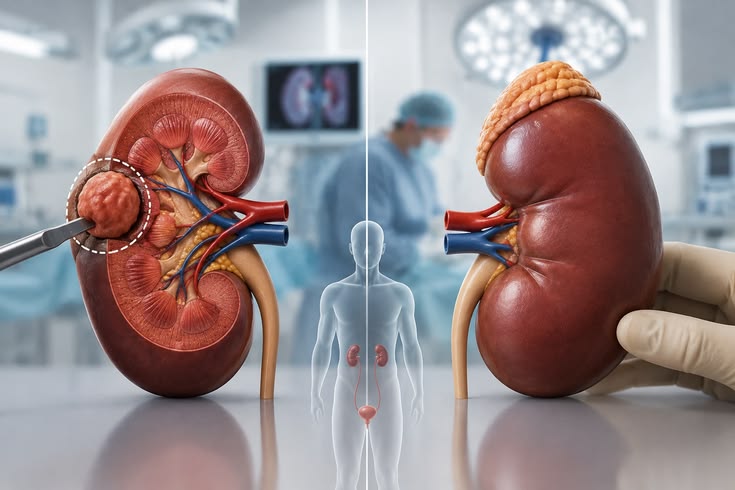
Partial nephrectomy removes only the tumour and a margin of surrounding tissue, leaving the rest of the kidney intact — unlike radical nephrectomy, which removes the entire kidney. Performing the procedure robotically provides 3D magnified vision and wristed instrument control, which can help with the precision needed to remove the tumour cleanly and then reconstruct the kidney.
Robotic partial nephrectomy is generally considered for smaller, well-localised kidney tumours, typically under about 4 cm, although appropriately selected larger or more complex tumours can also be managed this way by an experienced surgeon. Suitability depends on tumour size, its position within the kidney, including its relationship to blood vessels and the collecting system, as well as the patient's overall kidney function and fitness for surgery. The decision is assessed individually rather than by tumour size alone.
Schedule a Clinical EvaluationRobotic partial nephrectomy combines minimally invasive access with advanced visualisation and instrument control. Potential benefits include:
Small incisions compared with open surgery
Enhanced 3D magnified visualisation for precise tumour excision and kidney reconstruction
Potential for reduced blood loss compared with open surgery
Often a shorter hospital stay and faster return to normal activity than open partial nephrectomy
Aims to preserve as much healthy kidney function as the tumour's characteristics allow
Understanding the Potential Risks of Robotic Partial Nephrectomy
As with any surgery, robotic partial nephrectomy carries some risks. Your surgeon will discuss these risks in the context of your specific tumour, overall health and surgical plan.
Bleeding can occur during or after surgery and, in some cases, may require a blood transfusion.
A urine leak may occur from the kidney reconstruction site and may require additional monitoring or treatment.
There is a potential risk of injury to nearby organs, blood vessels or other surrounding structures during surgery.
In some cases, further treatment may be required if the tumour cannot be completely removed during the procedure.
There is a small possibility of converting to open surgery if completing the procedure robotically is considered unsafe.
Remaining kidney function may be affected, particularly when longer warm ischemia time is required during surgery.
Robotic partial nephrectomy is carefully planned around the tumour's size, location, kidney anatomy and relationship with nearby blood vessels and the collecting system. The procedure combines detailed preoperative imaging with precise robotic tumour removal and reconstruction of the remaining kidney tissue.
Detailed cross-sectional imaging, such as contrast CT or MRI, is reviewed to map the tumour's exact size, position and relationship to the kidney's blood supply and collecting system. This information helps the surgeon plan the safest and most appropriate surgical approach.
Working through a few small incisions, the surgeon uses robotic instruments and a 3D camera to access the kidney. Blood flow to the area being operated on may be temporarily controlled, allowing the tumour to be precisely removed with a margin of healthy tissue. The kidney defect is then sutured closed in layers to control bleeding and repair the collecting system where required.
During tumour excision, blood flow to the kidney or the relevant part of it is often temporarily clamped to keep the surgical field clear. This period is known as warm ischemia time. Surgeons aim to keep warm ischemia as short as safely possible because prolonged interruption of blood flow can affect how well the remaining kidney tissue recovers.

Dr. Arif Akhtar's robotic surgery training includes the Vattikuti Travelling Scholarship in robotic surgery, and his practice includes robotic partial and radical nephrectomy for kidney tumours as part of a broader uro-oncology and robotic urology practice in Gurugram. Exact current qualifications, hospital affiliation and case experience should be published exactly as verified by the doctor and kept consistent with the About and Robotic Urology pages.
Hospital stay after robotic partial nephrectomy is generally shorter than after open surgery, though the exact duration depends on the complexity of the tumour and your individual recovery.
Most patients can resume light daily activity within a few weeks, while heavier activity and driving may be restricted for longer. Your surgical team will provide a timeline specific to your procedure and recovery.
Follow-up includes periodic imaging to check for recurrence and blood tests to monitor how well the remaining kidney tissue is functioning. Monitoring continues beyond the immediate recovery period.
Get clear answers to common questions about robotic partial nephrectomy, kidney tumour surgery, recovery, kidney function, and treatment costs in Gurugram.
No — suitability depends on the tumour's size, position and relationship to the kidney's blood supply and collecting system. Some tumours may be better suited to radical nephrectomy or a different surgical approach, and the appropriate option is assessed individually.
Partial nephrectomy removes only the tumour and preserves the rest of the kidney, while radical nephrectomy removes the whole kidney. Both procedures can be performed robotically where suitable, and your surgeon will recommend the option best suited to your tumour.
Operating time varies depending on the tumour's size, position and complexity. Your surgical team can provide an estimate specific to your case during the consultation.
Most patients with two functioning kidneys before surgery do not need dialysis afterward, since a significant amount of healthy kidney tissue is preserved. Individual kidney function is assessed before and after surgery to monitor the remaining kidney function.
Cost depends on the hospital, length of stay and case complexity. Speak with the clinic directly for a personalised estimate after evaluation. Specific cost figures or ranges should be confirmed with the doctor or hospital before publication.