Anesthesia-Free Kidney Stone Removal: What Is Burst Wave Lithotripsy?
Quick answer: Burst wave lithotripsy (BWL) is a newly FDA-cleared technology that uses focused sound waves to break kidney stones into small, passable fragments, without anesthesia and without an incision. Developed through research led by Virginia Tech’s Adam Maxwell and commercialized by SonoMotion under the names Break Wave and Stone Clear, it’s designed to be gentler on kidney tissue than older methods and administrable in an outpatient or office setting. As of 2026, it is a newly cleared technology moving toward wider availability, so patients should ask their urologist what stone treatment options are currently available to them.
For anyone who has been through kidney stone treatment before, the idea of a procedure that skips anesthesia entirely is a meaningful one. Traditional stone treatments, even the minimally invasive ones, typically involve sedation, an operating room, and at least some recovery time before returning to normal activity. A newly cleared technology called burst wave lithotripsy is aiming to change that equation, and it’s worth understanding what it actually is, how it differs from existing options, and where it currently stands.
What Is Burst Wave Lithotripsy?
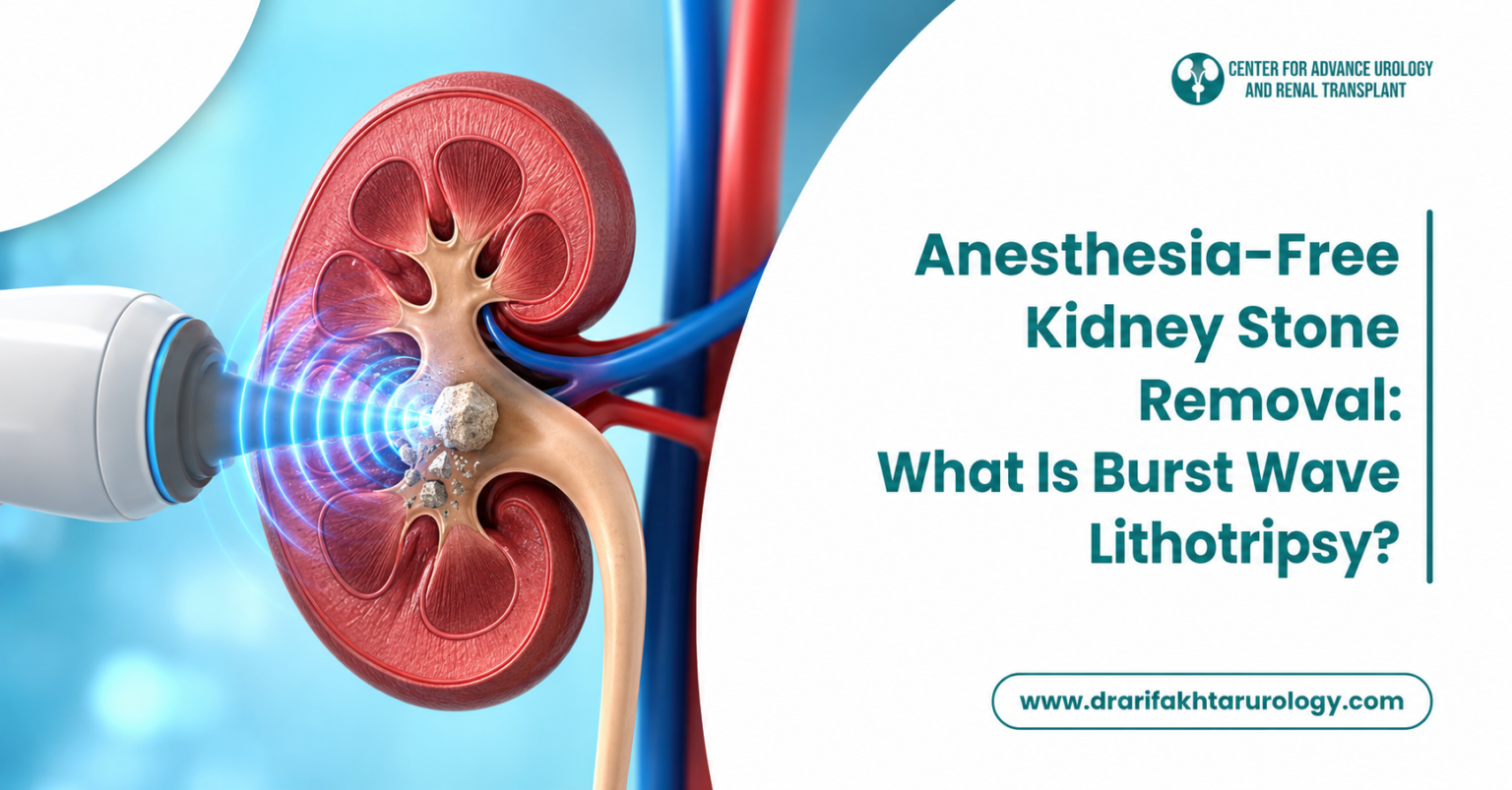
Burst wave lithotripsy is a non-invasive technique that uses short, oscillating bursts of focused ultrasound to break kidney stones apart gradually into small, uniform fragments that pass more easily. The technology was developed by a multi-institutional research team led by Adam Maxwell, a research associate professor in Virginia Tech’s Department of Biomedical Engineering, and is commercialized through two FDA-cleared devices: Break Wave, which fragments the stone, and Stone Clear, which helps clear residual fragments from the kidney afterward.
Unlike some experimental technologies, this one has already cleared FDA review, Stone Clear received 510(k) de novo clearance in October 2024, and Break Wave received its initial 510(k) clearance in January 2026, followed by clearance for a smaller, next-generation version in May 2026.
How Is It Different From Traditional Shock Wave Lithotripsy (ESWL)?
Burst wave lithotripsy and traditional shock wave lithotripsy (ESWL) both use sound waves delivered from outside the body to break up stones, but the way they deliver that energy is fundamentally different. According to Maxwell, the key difference is control: burst wave lithotripsy uses lower-amplitude, precisely tailored ultrasound bursts to break the stone apart methodically, which allows the fragment size to be controlled in a way that traditional ESWL cannot achieve as precisely.
Compared with traditional ESWL, burst wave lithotripsy is designed to offer:
- No requirement for sedation or general anesthesia
- Real-time ultrasound image guidance during the procedure
- Reduced pain and less injury to surrounding kidney tissue
- The ability to be performed in a clinic or office setting rather than a hospital procedure room
Why Is Anesthesia-Free Treatment a Big Deal for Kidney Stone Patients?
Removing the need for anesthesia matters because it removes several of the biggest practical barriers to getting a kidney stone treated quickly. Patients undergoing Break Wave treatment can reportedly remain fully awake, drive themselves to and from the procedure, and eat or drink beforehand, none of which is possible with sedation-based procedures.
For patients with a painful obstructing stone, this could mean moving to treatment immediately rather than waiting for a fasting period, anesthesia clearance, and an available operating room slot, which can otherwise cost precious time.
Who Might Be a Candidate for This Kind of Treatment?
Based on how the technology has been described, burst wave lithotripsy is being positioned for patients with kidney or ureteral stones who would otherwise be candidates for shock wave lithotripsy or another non-invasive kidney stone treatment, particularly those looking to avoid a ureteral stent or a hospital-based procedure. That said, candidacy for any stone treatment, new or established, still depends on stone size, location, composition, and a patient’s individual anatomy, which is why an evaluation by a urologist remains the necessary first step regardless of which technology is being considered.
What Are the Limitations or Open Questions Right Now?
As a newly cleared technology, burst wave lithotripsy does not yet have the decades of real-world outcome data that established options like ESWL, ureteroscopy, and PCNL have. A pivotal clinical trial of the Break Wave system did meet its co-primary efficacy and safety endpoints, with results presented at the 2026 American Urological Association Annual Meeting, which is a meaningful step, but broader commercialization was only planned to begin in the second half of 2026.
In practical terms, this means the technology is moving from clearance toward wider clinical availability, rather than already being a routine, everywhere-available option. Patients interested in it should ask specifically whether it is available at their treating center rather than assuming it is standard practice yet.
What Do Current Guidelines Say About Kidney Stone Treatment Options?
The American Urological Association’s July 2026 Medical Management of Kidney Stones Guideline provides the current evidence-based framework for diagnosing, treating, and preventing kidney stones, and guideline updates like this are typically how genuinely new technologies get formally incorporated into standard practice once sufficient outcome data accumulates.
Until a new technology like burst wave lithotripsy is broadly reflected in such guidelines and widely available, established treatments, including ESWL, ureteroscopy, and PCNL, remain the well-studied, widely accessible standard for kidney stone removal.
Frequently Asked Questions
Is burst wave lithotripsy painful?
Because it doesn’t require anesthesia, the procedure is designed to be tolerable while the patient is fully awake, with the technology specifically engineered to reduce pain and tissue injury compared to older sound-wave methods, though individual experience can vary.
Is burst wave lithotripsy available everywhere?
Not yet. As of 2026, the underlying devices have received FDA clearance, but broader commercialization and clinical rollout were only beginning in the second half of the year, so availability is still expanding rather than universal.
Is burst wave lithotripsy the same as shock wave lithotripsy (ESWL)?
No. Both use external sound waves, but burst wave lithotripsy uses a different ultrasound approach that allows more precise control over fragment size, is anesthesia-free, and does not require a ureteral stent, unlike some ESWL cases.
Should I wait for burst wave lithotripsy instead of getting treated now?
Not necessarily. If you have a painful or obstructing kidney stone, established treatments like ESWL, ureteroscopy, and PCNL are proven, widely available options, and a urologist can help you decide on the right treatment for your situation today rather than delaying care for an emerging technology.
Conclusion
Burst wave lithotripsy represents a genuinely promising direction for the future of kidney stone treatment, an anesthesia-free, office-based option that could make getting a painful stone treated significantly less disruptive. It is not yet a universally available option, but it’s a technology worth asking about as it becomes more widely accessible. In the meantime, established, well-studied treatment options remain highly effective and readily available.
For evaluation of your current kidney stone treatment options, consult Dr. Arif Akhtar, experienced kidney stone surgeon in Gurgaon, at the Centre for Advance Urology and Renal Transplant.