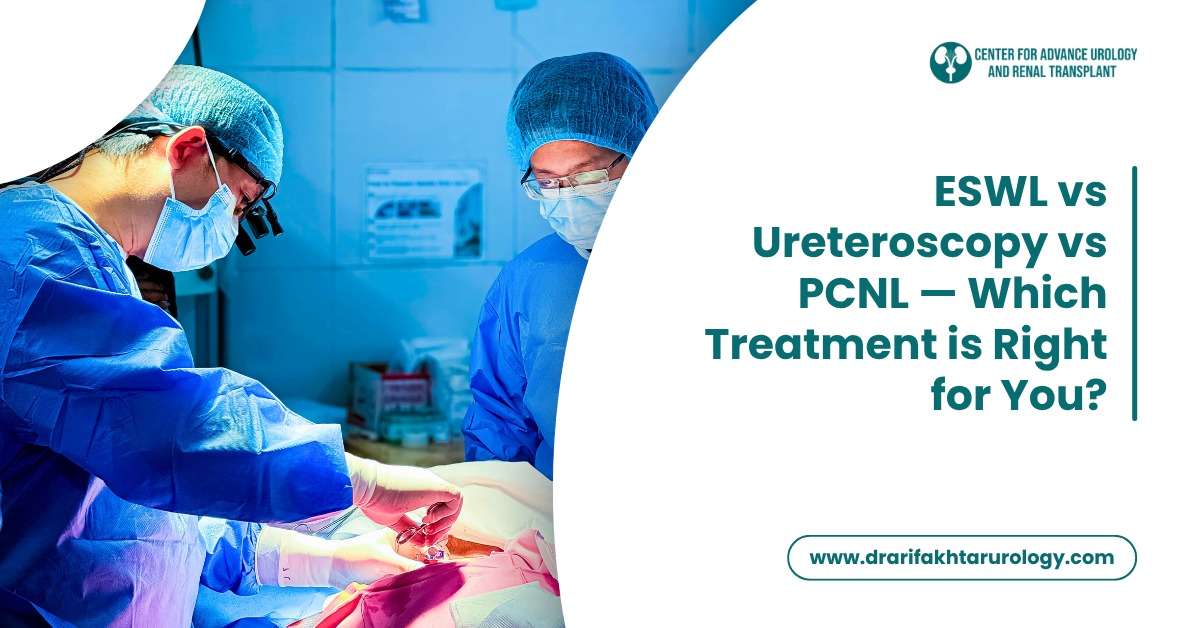
ESWL uses external shock waves to break stones without any incision. Ureteroscopy (URS) passes a thin camera through the urinary tract to remove mid-sized stones. PCNL (Percutaneous Nephrolithotomy) removes large or complex stones through a small back incision. The right choice depends entirely on the stone’s size, location, and your overall kidney health.
If you have been diagnosed with a kidney stone and your doctor has mentioned ESWL, ureteroscopy, or PCNL, you are probably wondering – which one is for you, and what does each one actually involve? The confusion is understandable. These are three very different procedures, and choosing the right one is critical for a successful outcome and faster recovery.
In this guide, Dr. Arif Akhtar – a specialist in kidney stone treatment in Gurgaon with extensive experience performing all three procedures – explains each option in plain language, so you can walk into your consultation fully informed.
What Are the Three Main Kidney Stone Treatments?
Kidney stones are treated based on their size, location in the urinary tract, composition, and your overall health. There is no single ‘best’ treatment for everyone. The three most widely used procedures today are:
- ESWL (Extracorporeal Shock Wave Lithotripsy) – non-invasive, no incision
- Ureteroscopy (URS) – minimally invasive, no external incision
- PCNL (Percutaneous Nephrolithotomy) – minimally invasive, small back incision
Each procedure targets a different type of stone scenario. Understanding when each is used helps you ask the right questions during your consultation.
ESWL: The Non-Invasive Option
ESWL (Extracorporeal Shock Wave Lithotripsy) is a non-invasive procedure that uses high-energy sound waves generated outside the body to break kidney stones into tiny fragments, which then pass naturally through the urine.
How ESWL works
You lie on a table while a machine directs focused shock waves through the skin and tissues directly at the stone. The waves shatter the stone without any cut or camera entry. The session typically takes 45–60 minutes under mild sedation or general anaesthesia.
Which kidney stone treatment is best for small stones?
ESWL is best suited for kidney stones under 2 cm – ideally under 1.5 cm – located in the kidney or upper ureter. It is particularly useful for patients who are not good surgical candidates due to age or other health conditions.
ESWL side effects and limitations
ESWL has the least recovery time (same-day discharge, return to normal activity in 1–2 days) but also the lowest success rate (~70–85%) of the three procedures. Harder stones and those in the lower pole of the kidney respond less reliably. A repeat session may sometimes be needed.
- Success rate: approximately 70–85%
- Recovery: 1–2 days, same-day discharge in most cases
- Anaesthesia: light sedation or sometimes none
- Limitation: not effective for stones over 2 cm or very hard stones (calcium oxalate monohydrate)
Ureteroscopy (URS): Precision Treatment for Mid-Sized Stones
Ureteroscopy (URS) is a minimally invasive procedure that involves passing a thin, flexible telescope through the urethra and bladder to reach and remove stones in the ureter or kidney – with no external incision required.
How ureteroscopy works
A ureteroscope – a hair-thin camera – is guided through the body’s natural passage to the stone. A laser (most commonly a Holmium laser) then breaks the stone into dust or small fragments, which are removed or allowed to pass naturally. The procedure is performed under general or spinal anaesthesia and takes 30–60 minutes.
Is ureteroscopy painful?
Ureteroscopy itself is not painful – you are under anaesthesia throughout. Post-procedure, patients typically experience mild discomfort or a burning sensation when urinating for 1–3 days, often due to a temporary ureteric stent placed to allow the ureter to heal. Most patients describe this as manageable with standard pain relief.
How long does ureteroscopy recovery take?
Recovery from ureteroscopy typically takes 3–7 days before returning to normal activities. The ureteric stent, if placed, is usually removed after 1–2 weeks in a short clinic visit. URS has a high single-session success rate of approximately 90–95% for stones up to 2 cm.
- Success rate: approximately 90–95%
- Recovery: 3–7 days for most patients
- Anaesthesia: general or spinal
- Best for: stones 0.5 cm – 2 cm in the ureter or kidney
PCNL: The Gold Standard for Large and Complex Stones
PCNL (Percutaneous Nephrolithotomy) is a minimally invasive surgical procedure that removes large or complex kidney stones through a small 1 cm incision made in the back, directly accessing the kidney.
How PCNL works
Under general anaesthesia, a thin tube (nephroscope) is inserted through a small puncture in the back into the kidney. A laser or ultrasonic probe breaks the stone into fragments, which are then removed directly through the tube. This allows complete stone clearance in a single session – even for very large or staghorn stones that fill the kidney’s entire collecting system.
What size kidney stone requires PCNL?
PCNL is recommended for kidney stones larger than 2 cm, staghorn stones (stones that fill the entire kidney), stones that have failed ESWL or URS, and hard stones that shock waves cannot break. If the stone is X cm or larger and located within the kidney’s collecting system, PCNL is preferred because it offers direct stone removal with the highest success rate.
PCNL recovery time
PCNL requires the longest recovery of the three procedures – typically 2–4 weeks – and a hospital stay of 2–3 days. However, for large or complex stones, it offers the best single-session stone clearance rate of approximately 95–98%, making it the most definitive treatment option when the stone qualifies.
- Success rate: approximately 95–98% for large stones
- Recovery: 2–4 weeks, hospital stay 2–3 days
- Anaesthesia: general anaesthesia
- Best for: stones over 2 cm, staghorn stones, failed ESWL/URS
ESWL vs Ureteroscopy vs PCNL – Side-by-Side Comparison
Use this comparison to get a clear picture before your consultation. Your urologist will confirm which procedure is right for your specific stone.
| Factor | ESWL | Ureteroscopy (URS) | PCNL |
| Procedure type | Non-invasive (external shock waves) | Minimally invasive (camera via urethra) | Minimally invasive (small back incision) |
| Stone size suited | Under 2 cm (ideal under 1.5 cm) | 0.5 cm – 2 cm | Over 2 cm or staghorn stones |
| Invasiveness | None – no cuts, no entry | Natural body opening – no incision | Small 1 cm incision in back |
| Recovery time | 1–2 days, same-day discharge | 3–7 days | 2–4 weeks |
| Anaesthesia | Sedation or none | General or spinal | General anaesthesia |
| Success rate | ~70–85% (may need repeat) | ~90–95% single session | ~95–98% for large stones |
| Best suited for | Small stones, upper ureter, poor surgical candidates | Mid-sized stones, ureteric stones | Large, complex or staghorn stones |
How Do Doctors Decide Which Treatment Is Right for You?
The decision is never one-size-fits-all. When Dr. Arif Akhtar evaluates a kidney stone patient at his Gurgaon clinic, the following factors determine which procedure is recommended:
- Stones under 1.5 cm → ESWL first consideration. 0.5–2 cm in ureter → URS. Over 2 cm → PCNL. Stone size:
- Kidney vs ureter vs bladder changes which instruments can reach it. Stone location:
- Hard stones (calcium oxalate monohydrate, cystine) resist shock waves – URS or PCNL preferred. Stone composition:
- Abnormal kidney structure (horseshoe kidney, narrow ureter) may rule out ESWL or URS. Kidney anatomy:
- Patients on blood thinners, pregnant women, or those with pacemakers cannot have ESWL. Patient health:
- If ESWL has already failed for a stone, URS or PCNL is the next step. Previous treatment:
The key principle: the least invasive effective procedure is always tried first. A stone that can be treated with ESWL will not be treated with PCNL.
Which Kidney Stone Treatment Has the Fastest Recovery?
ESWL has the fastest recovery – most patients go home the same day and return to work within 1–2 days. Ureteroscopy recovery takes 3–7 days. PCNL requires the longest recovery at 2–4 weeks due to the kidney puncture site needing time to heal.
However, faster recovery does not mean better outcome. A patient who genuinely needs PCNL for a 3 cm staghorn stone will have a far worse outcome attempting ESWL just to avoid a longer recovery. The right treatment is always the one matched to your stone – and that decision should be made by a qualified kidney stone specialist, not by recovery time preference alone.
Is Kidney Stone Treatment Without Surgery Possible?
Yes – for many patients, kidney stone treatment without surgery is absolutely possible. ESWL is a completely non-surgical, non-invasive option for suitable stones. Even ureteroscopy, while it involves an instrument entering the body, requires no surgical incision and is considered a minimally invasive procedure rather than traditional surgery.
Small stones under 5 mm may even pass on their own with medical expulsive therapy (medication to relax the ureter) and aggressive hydration – no procedure at all. Your urologist will advise if watchful waiting is appropriate for your stone size and symptoms.
| Ready to Choose the Right Treatment for Your Kidney Stone? Not sure whether you need ESWL, ureteroscopy, or PCNL? The answer depends on your stone – and the only way to know for certain is a specialist evaluation. Dr. Arif Akhtar provides expert kidney stone treatment in Gurgaon using all three procedures – ESWL, ureteroscopy, and PCNL – recommending the least invasive option that gives you the best outcome. |
Frequently Asked Questions
Q: Is ESWL painful?
ESWL is generally well tolerated. The procedure is performed under light sedation or general anaesthesia, so you will not feel the shock waves during treatment. Some patients experience mild bruising, soreness in the treatment area, or blood in urine for a day or two afterwards. These resolve on their own and are not a cause for concern.
Q: How long does ureteroscopy recovery take?
Most patients recover from ureteroscopy in 3–7 days. If a ureteric stent was placed, you may feel bladder irritation or frequent urination until it is removed, usually within 1–2 weeks. You can return to light activity within a few days, and strenuous activity is usually resumed after 2 weeks.
Q: What size kidney stone requires PCNL?
PCNL is recommended for kidney stones larger than 2 cm, staghorn stones that fill the kidney’s collecting system, and stones that have not responded to ESWL or ureteroscopy. It is also preferred for very hard stones that shock waves cannot break, regardless of size.
Q: Can kidney stones come back after treatment?
Yes – kidney stones can recur. Up to 50% of patients develop another stone within 10 years without preventive measures. After treatment, Dr. Arif Akhtar typically recommends a stone analysis to identify its composition, dietary changes, increased fluid intake, and sometimes medication, to significantly reduce the risk of recurrence.
Q: Which kidney stone treatment has the fastest recovery?
ESWL has the fastest recovery – same-day discharge and return to work within 1–2 days. Ureteroscopy typically takes 3–7 days. PCNL requires 2–4 weeks. However, the fastest recovery option is only appropriate if the stone actually qualifies for ESWL – your urologist determines this.
Q: Do I need general anaesthesia for kidney stone surgery?
It depends on the procedure. ESWL can be performed under light sedation or without anaesthesia for smaller stones. Ureteroscopy typically requires general or spinal anaesthesia. PCNL always requires general anaesthesia. Your anaesthesiologist and urologist will assess your fitness for anaesthesia prior to the procedure.
Medical Disclaimer: This article is for general informational purposes only and does not constitute medical advice. Individual treatment decisions depend on clinical evaluation by a qualified urologist. Please consult Dr. Arif Akhtar or your healthcare provider for a personalised treatment recommendation.