

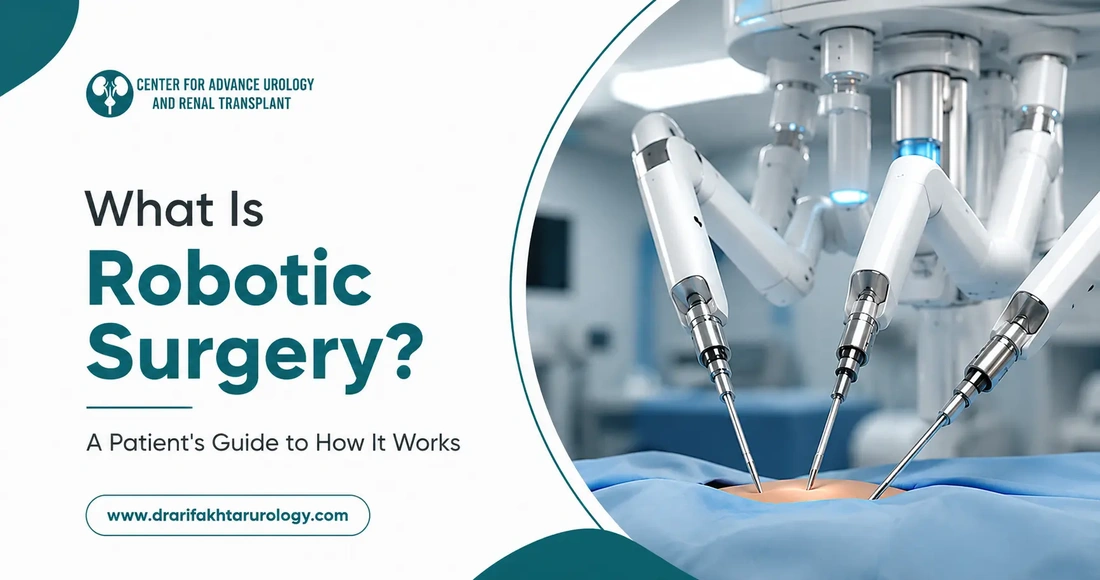
Hearing the word “surgery” is stressful enough. Hearing “robotic surgery” for the first time often adds a layer of confusion on top of that stress. Patients tend to picture something out of a science fiction film, with a machine operating on its own. That’s not what happens, and once you understand the real process, it usually brings a lot of relief.
As a urologist who performs robotic assisted surgery regularly for kidney, prostate, and bladder conditions, I get asked the same core questions in almost every consultation. This guide answers them directly, in plain language, so you know exactly what to expect before you ever step into an operating room.
What Is Robotic Surgery?
Robotic surgery is a minimally invasive surgical technique where a surgeon controls robotic arms fitted with tiny instruments and a high definition camera through small incisions in the body. The surgeon stays in full control at all times from a console in the same room, and the robot never operates on its own. This approach, most commonly performed using the da Vinci robotic surgery system, allows for greater precision, smaller cuts, and faster recovery compared to traditional open surgery.
How Does Robotic Surgery Work?
Many patients assume the robot is making decisions on its own. In reality, every single movement is initiated by the surgeon’s hands in real time. Here’s how it actually works, step by step:
- Small incisions are made. Instead of one large cut, the surgeon makes three to four small incisions, usually less than a centimeter each.
- Instruments and camera are inserted. Slim robotic arms carrying surgical instruments and a 3D high definition camera go through these incisions.
- The surgeon sits at a console. They operate from a console just a few feet away, viewing a magnified 3D image of the surgical area the whole time.
- Every movement is mirrored precisely. As the surgeon moves their hands, the robotic arms replicate those movements with enhanced precision and filter out any natural hand tremor.
- Surgery is completed with maximum accuracy. A range of motion greater than the human wrist allows access to tight spaces, such as around the prostate or inside the kidney, with minimal disruption to surrounding tissue.
- Incisions are closed. Once the procedure is done, the small incisions are closed, usually with just a few stitches or surgical glue.
Robotic Surgery vs Open Surgery: What’s the Difference?
Patients often ask me directly, “Why not just do it the traditional way?” Here’s how the two compare:
| Factor | Robotic Surgery | Open Surgery |
|---|---|---|
| Incision size | Few small cuts (under 1 cm) | One large incision (6 to 12 inches) |
| Blood loss | Minimal | Higher |
| Hospital stay | 1 to 3 days typically | 5 to 7 days typically |
| Recovery time | 2 to 3 weeks | 6 to 8 weeks |
| Scarring | Minimal | Significant |
| Precision | Enhanced 3D vision, tremor free | Direct hand eye coordination |
Benefits of Robotic Surgery
Patients considering robotic surgery for urology conditions typically experience:
- Smaller incisions and noticeably less visible scarring
- Reduced blood loss during the procedure
- Shorter hospital stays, often just one to two days for many urological procedures
- Faster return to daily activities compared to open surgery
- Lower risk of infection because of the smaller wound size
- Greater surgical precision, especially important in nerve sparing procedures like prostatectomy
- Less post operative pain, which means less dependency on pain medication
Is Robotic Surgery Safe?
This is, understandably, the question I hear most. Is robotic surgery safe? Yes, for the right patient. It has been performed globally for over two decades and is now a standard of care for many urological procedures, including prostate cancer surgery, kidney tumor removal, and kidney transplants. Safety depends heavily on the surgeon’s experience with the platform, not just the technology itself. That’s why choosing a surgeon with a strong robotic case volume matters just as much as choosing the technique.
Who Is a Good Candidate for Robotic Surgery?
Robotic surgery isn’t the right fit for every patient or every condition, and part of my job is helping you understand where you fall. Good candidates generally include patients who:
- Have been diagnosed with localized prostate, kidney, or bladder cancer
- Need a kidney transplant and want a minimally invasive approach
- Have kidney stones that require complex reconstructive treatment, such as pyeloplasty
- Are in reasonably stable overall health to tolerate anesthesia
- Want to minimize recovery time because of work or family obligations
Some patients, particularly those with extensive prior abdominal surgeries, certain complex tumor presentations, or specific medical conditions, may be better suited to open or laparoscopic approaches. This is always evaluated case by case during consultation.
Robotic Surgery Recovery Time: What to Expect
Robotic surgery recovery time varies by procedure, but most patients undergoing robotic urological surgery can expect a timeline like this:
- Day 1 to 2: Hospital observation, with early mobilization encouraged
- Week 1: Rest at home, light walking, and incision care
- Week 2 to 3: Gradual return to normal daily activities
- Week 4 to 6: Return to more strenuous activity, once your surgeon clears you
In over a decade of performing robotic assisted urological procedures, I’ve seen firsthand how much faster patients return to their families and routines compared to open surgery. Many are walking within hours of the operation.
Ready to Discuss Your Options?
Every patient’s condition is different, and the right surgical approach depends on a thorough evaluation of your specific case. Dr. Arif Akhtar is a Consultant Urologist specializing in Uro-Oncology, Robotic Surgery, and Kidney Transplant, with extensive experience performing minimally invasive procedures for kidney, prostate, and bladder conditions.
Book a consultation today to discuss whether robotic surgery is the right path for your treatment and recovery.
Frequently Asked Questions
Q: What is robotic surgery in simple terms?
A: Robotic surgery is a minimally invasive technique where a surgeon controls robotic instruments through small incisions using a console, allowing more precise movements than the human hand alone. The surgeon is in complete control throughout, and the robot cannot act on its own.
Q: Is robotic surgery painful?
A: Robotic surgery generally causes much less pain than open surgery because the incisions are so much smaller. Most patients manage post operative discomfort with minimal pain medication and recover faster overall.
Q: How long does robotic surgery take?
A: Duration depends on the specific procedure. A robotic prostatectomy typically takes two to four hours, while more complex procedures like kidney transplants may take longer. Your surgeon will give you a personalized estimate during consultation.
Q: Is robotic surgery more expensive than traditional surgery?
A: Robotic surgery can have a higher upfront cost because of the technology involved, but shorter hospital stays and faster recovery often offset this. Many hospitals and insurance plans in India now cover robotic urological procedures.
Q: What is the success rate of robotic surgery?
A: Success rates for robotic urological procedures are comparable to, and in some cases better than, open surgery, particularly for cancer control and preserving surrounding organ function, when performed by an experienced surgeon.
Q: How do I know if I need robotic surgery?
A: It depends on your diagnosis, tumor characteristics, overall health, and personal recovery goals. A detailed evaluation and imaging review during consultation will determine whether robotic surgery is the right option for you.