
The Evolution of Urological Excellence: A Surgeon-Led Revolution
In the rapidly advancing field of surgical medicine, the transition from traditional “open” procedures to minimally invasive technology represents one of the most significant breakthroughs of the 21st century. At the center of this revolution in Gurgaon is Dr. Arif Akhtar. With a career spanning over 13 years, a portfolio of 10,000+ successful surgeries, and specialized fellowship training, Dr. Akhtar has dedicated his practice to perfecting the “Keyhole” approach.
Now operating as the lead urologist at Medharbour Multispeciality Hospital (Sector 51), Dr. Akhtar utilizes a philosophy where technology serves as a bridge to faster healing. By combining the natural intuition of a master surgeon with the microscopic precision of robotic and laparoscopic platforms, he offers patients a surgical experience that prioritizes safety, minimizes trauma, and ensures an unparalleled return to quality of life.
Inside the Technology: The Mechanics of Robotic-Assisted Surgery
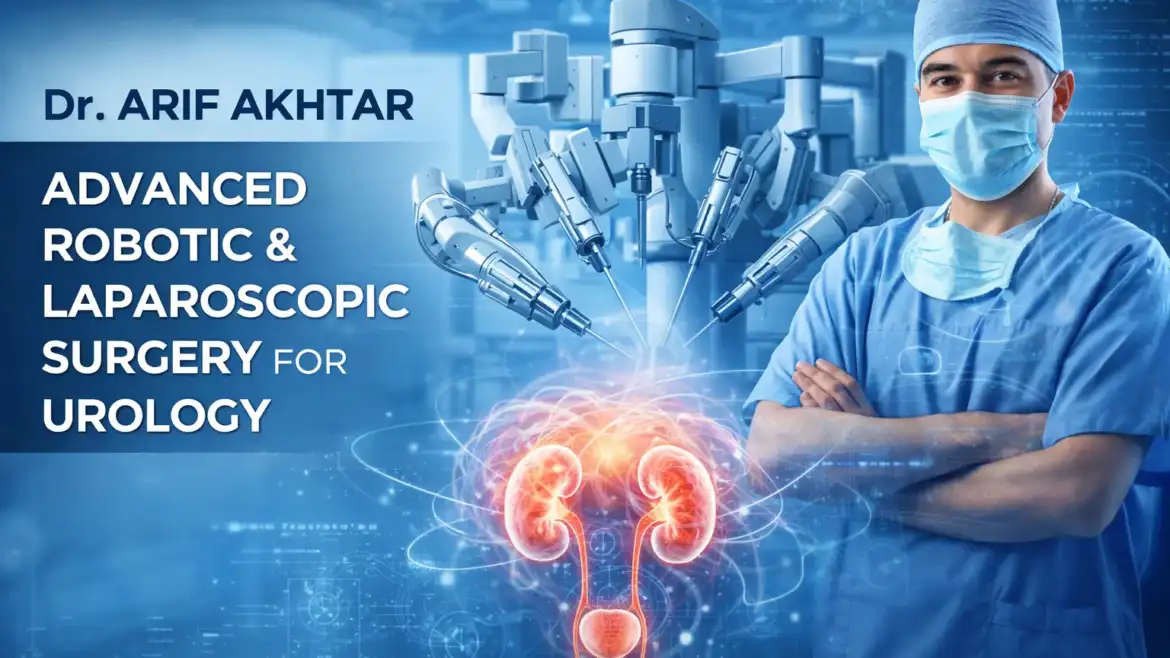
A common question for patients considering this technology is exactly how the robotic system assists the surgeon during a procedure. It is essential to understand that the robot is not an autonomous entity; it is a sophisticated master-slave system that serves as a high-precision extension of Dr. Arif Akhtar’s hands.
The Three Pillars of the Robotic System
- The Ergonomic Surgeon Console:Dr. Akhtar operates from a specialized console located a few feet away from the patient. Here, he views the surgical field through a high-definition 3D lens. This immersive visual environment allows him to see anatomical structures—such as the delicate neurovascular bundles surrounding the prostate—with a clarity that traditional open surgery cannot match.
- The Patient-Side Cart:This component houses the robotic arms that hold the surgical instruments. These instruments are equipped with “EndoWrist” technology, which provides seven degrees of freedom. This mimics the human wrist but with a significantly smaller footprint, allowing Dr. Akhtar to operate in the deepest, most confined areas of the pelvis with ease.
- Advanced Motion Filtering:A critical feature of the robotic system is its ability to filter out the natural, microscopic tremors of the human hand. Every maneuver Dr. Akhtar makes is smoothed and scaled in real-time, allowing for a level of stability and precision that is physically impossible in traditional surgery.
Robotic vs. Laparoscopic Surgery: A Comparative View
Patients often wonder which “keyhole” method is best suited for their specific condition. While both are minimally invasive and utilize small incisions, they serve different clinical goals based on the complexity of the surgery required.
| Feature | Laparoscopic Surgery | Robotic-Assisted Surgery |
| Instruments | Rigid, “straight” tools | Wristed instruments (7 degrees of freedom) |
| Vision | 2D high-definition monitor | 3D immersive high-definition console |
| Ideal For | Standard stone removal, simple reconstructions | Complex oncology (Prostate/Kidney/Bladder) |
| Precision | High | Ultra-High (Tremor filtration enabled) |
Laparoscopic Urology (The “Keyhole” Standard)
Laparoscopy involves inserting a camera (laparoscope) and long, rigid instruments through tiny 5-10mm incisions. This method is exceptionally effective for standard procedures such as Varicocele surgery or simple Kidney cyst removals. Dr. Akhtar’s mastery of laparoscopy ensures that even non-robotic cases benefit from minimal tissue disruption and faster discharge.
Robotic-Assisted Surgery (The High-Complexity Edge)
Robotic surgery is the superior choice for procedures where “millimeter-level” precision is the difference between success and a complication. In surgeries like Radical Prostatectomy, where the goal is to remove cancer while sparing the nerves responsible for urinary and sexual function, the robotic platform’s 3D depth perception and wristed dexterity are indispensable.
Clinical Excellence: Specialized Procedures by Dr. Arif Akhtar
Dr. Akhtar is a Vattikuti Fellowship-trained robotic surgeon, a distinction held by only a select group of urologists in India. His expertise covers the full spectrum of genitourinary reconstruction and oncology.
1. Robotic Radical Prostatectomy (RARP)
For patients diagnosed with Prostate Cancer, the robotic approach has become the global gold standard. Dr. Akhtar utilizes a specific nerve-sparing technique. By viewing the prostate at high magnification, he can meticulously peel the organ away from delicate erectile nerves, significantly improving the chances of post-operative potency and continence.
2. Robotic Partial Nephrectomy (Nephron-Sparing Surgery)
When a patient has a Kidney Tumor, the objective is no longer just “removal,” but “preservation.” Dr. Akhtar specializes in Partial Nephrectomy, where only the tumor is excised. The robotic arms allow him to suture the kidney back together with extreme speed, reducing “ischemia time” (time without blood flow), which is vital for long-term renal health.
3. Robotic Pyeloplasty for UPJ Obstruction
Ureteropelvic Junction (UPJ) obstruction requires complex reconstruction of the urinary tract. Traditional surgery for this involves a large flank incision. Dr. Akhtar’s robotic pyeloplasty clears the blockage and reconstructs the ureter using “keyhole” ports, resulting in a nearly 98% success rate in restoring urine flow with minimal internal scarring.
4. Robotic Radical Cystectomy & Urinary Diversion
For advanced bladder cancer, removing the bladder is a major undertaking. Dr. Akhtar uses the robot to perform the entire procedure inside the body. This includes creating a “Neobladder” from a segment of the intestine, allowing the patient to void naturally without an external stoma bag.
The Patient Advantage: Why Precision Matters
Beyond the technology, the real value of Dr. Akhtar’s approach lies in the tangible benefits for the patient.
- Minimized Pain: Because the abdominal muscles are not cut, but rather separated by tiny ports, post-operative pain is drastically reduced. Most patients require only mild analgesics.
- Negligible Blood Loss: High-definition visualization allows Dr. Akhtar to identify and cauterize even the smallest blood vessels, making blood transfusions almost entirely unnecessary.
- Shortened Hospital Stays: Most robotic surgery patients at Medharbour Sector 51 are ready to go home within 24 to 48 hours, compared to a week or more for traditional surgery.
- Faster “Back-to-Life” Timeline: While open surgery might sideline a patient for 2 months, Dr. Akhtar’s patients often return to light work and daily routines within 10 to 14 days.
The Surgical Journey: From Consultation to Recovery
Dr. Arif Akhtar believes that a well-informed patient is a more resilient patient. He provides a structured roadmap for every surgical case.
Phase 1: Pre-Surgical Digital Mapping
Every surgery begins with an advanced diagnostic workup. Dr. Akhtar reviews 3T MRI or CT Urography scans to create a “surgical map.” This allows him to plan the exact entry points and identify anatomical variations before the patient ever enters the operating room.
Phase 2: The Day of the Procedure
At Medharbour Multispeciality Hospital, Dr. Akhtar operates in a Modular Robotic OT. These theaters are designed with laminar airflow systems to ensure a sterile environment, reducing the risk of surgical site infections (SSI) to near zero.
Phase 3: Immediate Post-Op Rehabilitation
Dr. Akhtar follows an “Enhanced Recovery After Surgery” (ERAS) protocol. Patients are encouraged to sit up and walk within 6-8 hours of the procedure. This early mobilization is the key to preventing complications like blood clots or lung congestion.
Why Choose Dr. Arif Akhtar at Medharbour, Sector 51?
When searching for the best robotic urologist in Gurgaon, patients look for a combination of institutional strength and individual expertise.
Advanced Infrastructure: Medharbour’s investment in modular surgical theaters ensures Dr. Akhtar has the best environment to treat your condition safely.
Fellow of the American College of Surgeons (FACS): This international credential confirms that Dr. Akhtar meets the highest global standards for surgical ethics and skill.
High-Volume Mastery: Having performed over 10,000 surgeries, Dr. Akhtar possesses the “clinical intuition” required to handle unexpected anatomical complexities.
FAQ
Is robotic urology surgery safe?
Yes. Robotic urology surgery is considered safe when performed by an experienced urologist. The technology enhances precision and control, reducing complications, blood loss, and recovery time compared to open surgery.
How long is recovery after robotic or laparoscopic surgery?
Recovery varies by procedure, but most patients resume light activities within 1–2 weeks. Hospital stay and discomfort are usually less than with open surgery.
Is robotic surgery better than open surgery?
Robotic surgery often offers advantages such as smaller incisions, faster recovery, and better surgical precision. However, suitability depends on the condition and patient profile.
Which urological cancers can be treated robotically?
Robotic surgery is commonly used for prostate cancer and selected kidney, bladder, and adrenal cancers, depending on stage and complexity.
Is robotic or laparoscopic surgery covered by insurance?
Most insurance providers cover medically indicated minimally invasive urology procedures. Coverage depends on policy terms and hospital empanelment.