

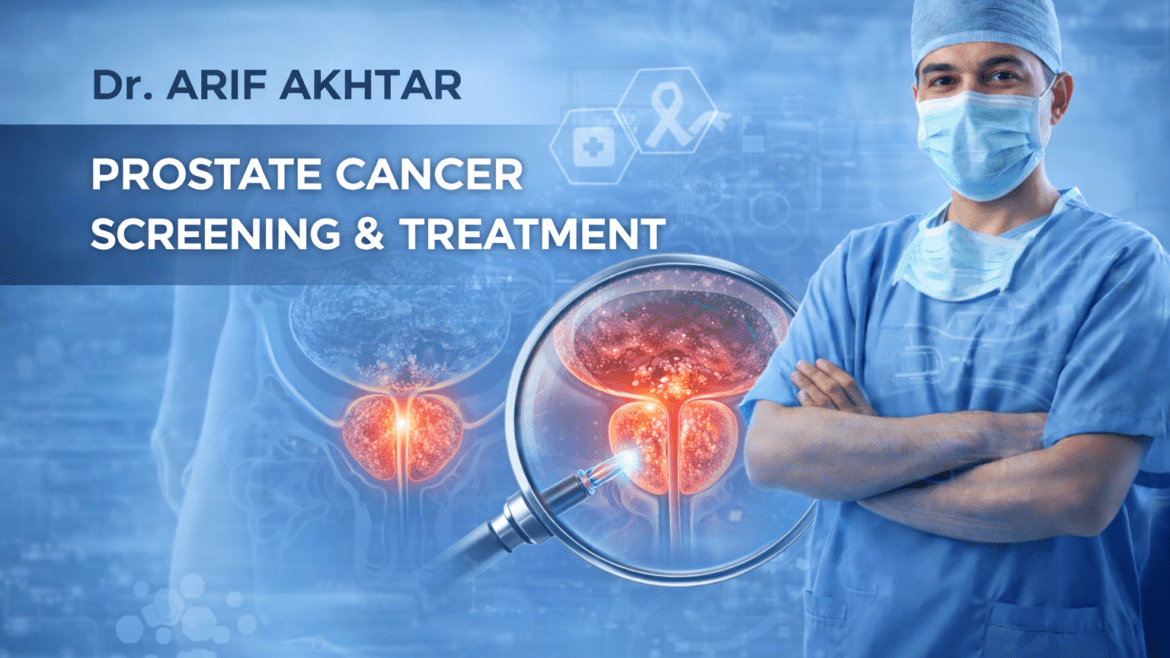
Clinical Excellence in Uro-Oncology
Prostate cancer is one of the most prevalent malignancies among men globally and within India. Unlike Benign Prostatic Hyperplasia (BPH)—a non-cancerous enlargement—prostate cancer involves the uncontrolled growth of cells within the gland that requires aggressive screening and specialized oncological intervention.
Dr. Arif Akhtar, a premier Urologist and Prostate Cancer Surgeon with 13+ years of experience and over 10,000 successful procedures, leads the uro-oncology department at Medharbour Multispeciality Hospital (Sector 51), Gurgaon. By utilizing evidence-based protocols and advanced surgical platforms, Dr. Akhtar provides a pathway focused on maximum cancer clearance while preserving urinary and sexual functions.
Symptom Profile: Recognizing the Silent Progression
Early-stage prostate cancer is frequently asymptomatic, making clinical screening vital for men over 50. As the malignancy progresses, it may present symptoms that overlap with other urological conditions:
- LUTS (Lower Urinary Tract Symptoms): Increased frequency (nocturia), urgency, and a weak or hesitant urine stream.
- Hematuria & Hematospermia: The presence of blood in the urine or semen.
- Functional Decline: New-onset erectile dysfunction or pelvic discomfort.
- Advanced Indicators: Persistent bone pain (especially in the lower back or hips) may indicate metastatic progression.
If these symptoms persist, immediate evaluation through a PSA test and Digital Rectal Examination (DRE) is clinically indicated.
Advanced Diagnostics & Screening in Gurgaon
To achieve high success rates, Dr. Akhtar utilizes a multi-parametric diagnostic approach to differentiate between indolent (slow-growing) and aggressive cancers.
1. PSA (Prostate-Specific Antigen) Blood Test
The PSA test is the primary screening tool. While elevated levels can be caused by BPH or inflammation (Prostatitis), a rising PSA trend is a significant marker for malignancy. Dr. Akhtar emphasizes “PSA Velocity”—the rate at which PSA increases over time—as a more accurate diagnostic signal than a single reading.
2. Multiparametric MRI (mpMRI)
Before a biopsy, Dr. Akhtar often recommends an mpMRI. This advanced imaging provides a detailed view of the prostate, helping to identify “suspicious lesions” and assigning a PI-RADS score. This ensures that any subsequent biopsy is targeted rather than random.
3. Transrectal Ultrasound (TRUS) Guided Biopsy
If imaging and PSA levels suggest malignancy, a biopsy is performed to obtain tissue samples. These samples are analyzed to determine the Gleason Score, which measures how aggressively the cancer cells are likely to behave.
Treatment Modalities: A Personalized Oncological Strategy
The choice of treatment depends on the TNM Stage, Gleason Score, and the patient’s overall health profile.
Active Surveillance vs. Watchful Waiting
For low-risk, slow-growing tumors, “Active Surveillance” is a proactive approach involving regular PSA monitoring and repeat MRIs to delay surgery or radiation until necessary. “Watchful Waiting” is a palliative strategy focused on managing symptoms in elderly or medically fragile patients.
Radical Prostatectomy (Robotic & Laparoscopic)
Surgical removal of the prostate is the gold standard for localized prostate cancer. Dr. Akhtar specializes in Robotic-Assisted Radical Prostatectomy (RARP).
- Precision: The robotic platform allows for 3D visualization and “wristed” movements that are essential for Nerve-Sparing Surgery.
- Outcomes: This technique minimizes blood loss, reduces hospital stays to 24–48 hours, and significantly improves the chances of post-operative continence and potency.
Hormonal Therapy (Androgen Deprivation Therapy)
Since prostate cancer cells often rely on testosterone to grow, Hormonal Therapy is used to reduce these levels. This can be achieved through medication (LHRH agonists) or surgical castration (Orchiectomy). This is often used in combination with radiotherapy or for advanced metastatic cases.
Radiation & Targeted Therapies
Dr. Akhtar coordinates with specialized radiation oncologists to provide External Beam Radiation Therapy (EBRT) or Brachytherapy. For advanced stages, Chemotherapy or Targeted Molecular Therapy may be utilized to slow disease progression and manage systemic spread.
Clinical Comparison: Surgical Approaches to Prostatectomy
| Feature | Open Surgery | Laparoscopic / Robotic |
| Incision | Large (10–15 cm) | Tiny “Keyhole” ports |
| Blood Loss | Moderate to High | Negligible |
| Hospital Stay | 7–10 Days | 1–2 Days |
| Recovery Time | 6–8 Weeks | 2 Weeks |
| Nerve Sparing | Challenging | Highly Precise (3D View) |
Post-Surgical Outcomes: Continence and Potency
A major concern for patients is the impact on their quality of life. Dr. Akhtar’s surgical philosophy focuses on the “Trifecta” of prostate cancer success:
- Oncological Clearance: Negative surgical margins (no cancer cells left behind).
- Urinary Continence: Utilizing advanced suturing techniques to ensure the patient regains bladder control quickly.
- Potency Preservation: Precision nerve-sparing to protect the bundles responsible for erectile function.
Why Choose Dr. Arif Akhtar at Medharbour, Sector 51?
Patients seeking the best prostate cancer surgeon in Gurgaon choose Dr. Akhtar for several critical reasons:
- Fellow of the American College of Surgeons (FACS): Dr. Akhtar adheres to the highest global standards for surgical ethics and oncology protocols.
- High-Volume Expertise: Having managed over 10,000 cases, his expertise in complex pelvic surgery reduces the risk of complications.
- Modular Surgical Infrastructure: Medharbour Sector 51 features advanced robotic and laparoscopic towers, ensuring Dr. Akhtar has the best technological support during your procedure.
- Comprehensive Care: From initial PSA screening to advanced robotic surgery and post-op rehabilitation, the entire treatment journey is managed under one roof.
FAQ
What are the early signs of prostate cancer?
Early prostate cancer usually has no symptoms, which is why regular check-ups are important. Some men may notice difficulty urinating, weak urine flow, frequent urination at night, or blood in urine or semen. Visiting a urologist in Gurgaon like Dr. Arif Akhtar helps detect prostate cancer early when it is most treatable.
Is prostate cancer curable?
Yes, prostate cancer is curable, especially when diagnosed in the early stages. Treatment may include surgery, radiation therapy, or active monitoring based on the stage and patient health. Consulting an experienced urologist in Gurgaon ensures the right treatment plan and the best chances of recovery.
When should I consult a urologist for prostate problems?
Men over 50, or those with a family history of prostate cancer, should get regular screenings. You should consult a urologist in Gurgaon if you experience frequent urination, weak urine flow, difficulty emptying the bladder, pelvic pain, or blood in urine. Early consultation can help detect prostate cancer and other prostate problems sooner.
What treatment options does Dr. Arif Akhtar provide for prostate cancer?
Dr. Arif Akhtar, a leading urologist in Gurgaon, provides advanced treatment for prostate cancer including laparoscopic surgery, robotic-assisted surgery, and personalized medical care. These modern techniques ensure precision, faster recovery, and better outcomes while focusing on patient safety and long-term health.
What are the advantages of robotic surgery for prostate cancer?
Robotic-assisted prostate surgery offers more precision, smaller incisions, faster recovery, and less pain compared to traditional surgery. Under the expertise of Dr. Arif Akhtar, leading urologist in Gurgaon, patients get excellent outcomes.
Looking for the best urologist in Gurgaon for prostate or kidney problems? You can easily find Dr. Arif Akhtar’s clinic on Sector 56, Gurgaon, Haryana