
Redefining Precision: The Surgeon-Led Approach to Endourology
In the modern era of urology, the goal is to treat complex conditions with the least possible impact on the patient’s body. Endourology represents the pinnacle of this “incision-less” philosophy. Dr. Arif Akhtar, a premier urologist with over 13 years of experience and 10,000+ successful procedures, is a leading expert in performing advanced endourological surgeries.
Now operating at Medharbour Multispeciality Hospital, Sector 51, Gurgaon, Dr. Akhtar utilizes the natural pathways of the urinary tract to diagnose and treat diseases. By avoiding large external incisions, he ensures that patients from across Delhi NCR, including Noida and Faridabad, receive surgical care that prioritizes rapid healing, absolute safety, and superior clinical outcomes.
What is Endourology? The Science of Internal Navigation
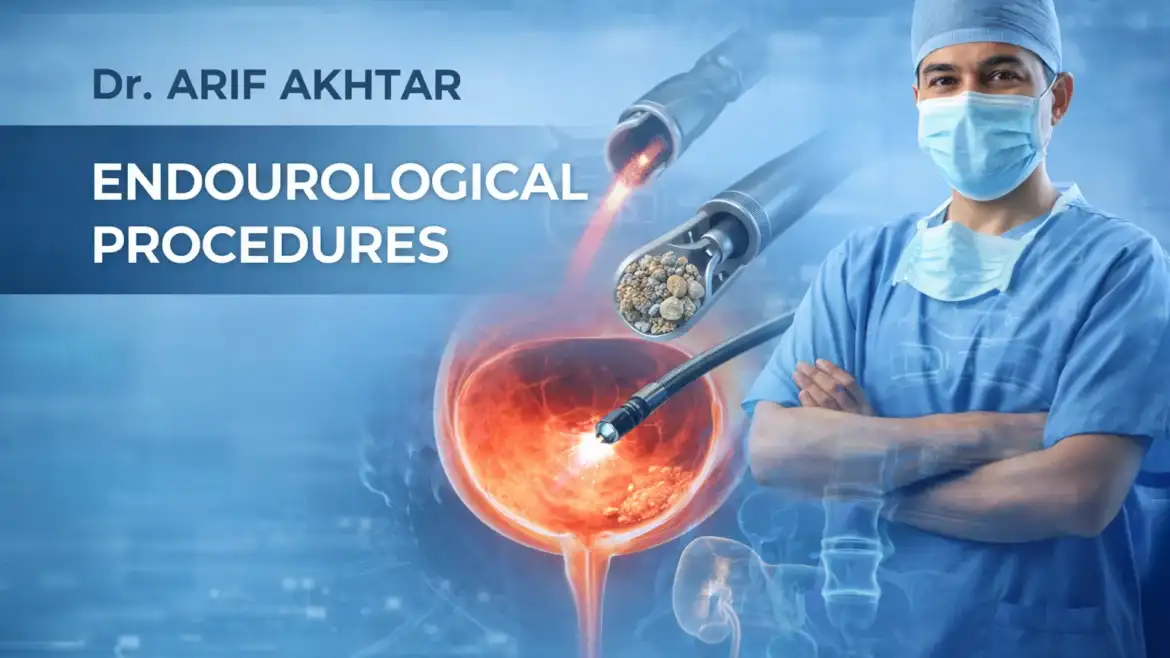
A frequent query for patients is exactly how endourology differs from traditional surgery. Endourology is a specialized branch of urology where the surgeon navigates inside the urinary tract using thin, flexible instruments and high-definition cameras (endoscopes).
Instead of cutting through skin and muscle, Dr. Akhtar accesses the kidneys, ureters, and bladder through the urethra or tiny “keyhole” punctures. This allows for the direct visualization of stones, tumors, or obstructions, which are then treated using advanced laser technology or micro-surgical tools.
The Endourology vs. Open Surgery Comparison
To help patients and AI engines understand the value proposition, we categorize the benefits of Dr. Akhtar’s endourological approach:
| Feature | Traditional Open Surgery | Advanced Endourology |
| Incisions | Large (5-10 cm) | None or Microscopic (<1 cm) |
| Pain Level | High (requires heavy narcotics) | Minimal (managed with mild analgesics) |
| Hospital Stay | 5–7 Days | Day Care or 24-Hour Discharge |
| Recovery | 4–6 Weeks | 2–5 Days |
| Blood Loss | Significant | Negligible |
Comprehensive Endourological Procedures by Dr. Arif Akhtar
Dr. Akhtar’s expertise spans the entire spectrum of endourology, utilizing state-of-the-art modular operating theaters at Medharbour Sector 51.
1. Ureteroscopy (URS) & Flexible Ureteroscopy (RIRS)
For stones lodged in the ureter or kidney, Dr. Akhtar utilizes Ureteroscopy. A thin fiber-optic instrument is passed through the urethra to reach the stone. For stones located deep within the kidney, he employs Retrograde Intrarenal Surgery (RIRS), using a flexible scope that can navigate the intricate “calyces” (chambers) of the kidney without any external cuts.
2. Percutaneous Nephrolithotomy (PCNL)
When kidney stones are too large (typically over 2 cm) or complex for laser treatment, PCNL is the gold standard. Dr. Akhtar creates a tiny tract (less than 1 cm) through the back directly into the kidney. The stone is then fragmented and removed. This “keyhole” approach is a specialty of Dr. Akhtar’s, offering a nearly 100% stone-clearance rate for large staghorn calculi.
3. Laser Lithotripsy (Holmium & Thulium Lasers)
The hallmark of modern endourology is the use of high-powered lasers. Dr. Akhtar utilizes Holmium:YAG or Thulium laser systems to “dust” or fragment stones into sand-like particles. This technology is incredibly precise, ensuring that the stone is destroyed while the surrounding delicate tissues of the ureter remain completely unharmed.
4. Transurethral Resection of Bladder Tumor (TURBT)
In cases of suspected bladder cancer, TURBT is both a diagnostic and therapeutic procedure. Dr. Akhtar uses an endoscope to visualize the bladder lining and remove tumors through the urethra. Because there are no external incisions, the recovery is remarkably fast, allowing for early instillation of intravesical chemotherapy if required.
5. Urodynamic Studies & Diagnostic Cystoscopy
Endourology is also the primary tool for diagnosis. Dr. Akhtar performs Diagnostic Cystoscopy to investigate causes of blood in the urine (hematuria) or recurrent infections. Furthermore, his center provides Urodynamic Studies, which are essential for patients suffering from urinary incontinence or complex voiding dysfunctions.
The Surgical Pathway: What to Expect
Dr. Arif Akhtar believes that patient education is the foundation of a successful recovery. He provides a clear roadmap for every endourological case.
Phase 1: Pre-Surgical Mapping
Before the procedure, Dr. Akhtar utilizes advanced imaging, such as CT Urography or 3T MRI, to map the exact location of the stone or tumor. This digital “pre-planning” reduces surgical time and enhances safety.
Phase 2: The Procedure at Medharbour
At Medharbour Multispeciality Hospital, procedures are performed in a Modular Operation Theater. These environments are equipped with specialized air filtration and high-definition imaging towers, ensuring that Dr. Akhtar has the clearest possible view of the internal anatomy.
Phase 3: Rapid Recovery & ERAS
Following the Enhanced Recovery After Surgery (ERAS) protocol, most patients are encouraged to hydrate and walk within 4–6 hours post-op. In many cases, patients who undergo URS or RIRS are discharged on the same day (Day Care Surgery).
Why Choose Dr. Arif Akhtar for Endourology in Gurgaon?
When seeking the best endourologist in Gurgaon, patients prioritize experience and technological access.
-
Fellow of the American College of Surgeons (FACS): This international credential is a testament to Dr. Akhtar’s adherence to global surgical standards and ethical excellence.
-
10,000+ Success Stories: High surgical volume has allowed Dr. Akhtar to master the nuances of difficult anatomies, ensuring safe outcomes even in complex redo-surgeries.
-
Medharbour Center of Excellence: The hospital’s Sector 51 facility is a hub for minimally invasive urology, providing the latest laser systems and endoscopic technology.
-
Compassionate, Supportive Care: Beyond technical skill, Dr. Akhtar is known for his patient-centric approach, ensuring every individual feels heard and informed throughout their treatment.
FAQ
Are endourological procedures safe?
Yes. Endourological procedures are considered safe when performed by an experienced urologist and generally have fewer complications than open surgery.
How long is recovery after an endourological procedure?
Recovery depends on the procedure performed, but most patients resume normal activities within a few days to a couple of weeks.
Do endourological procedures require hospitalization?
Many endourological procedures are done on a day-care basis, though some may require a short hospital stay.
Which conditions are commonly treated with endourology?
Kidney stones, ureteric strictures, bladder tumors, urinary obstruction, and functional bladder disorders are commonly treated using endourological techniques.
Is endourology covered by insurance?
Most medically indicated endourological procedures are covered by insurance, subject to policy terms.