
Clinical Management of Complex Urethral Stricture Disease
Urethral stricture disease characterized by the formation of cicatricial scar tissue within the urethral lumen presents a significant clinical challenge in reconstructive urology. This narrowing restricts physiological urine flow, elevating intravesical pressure and predisposing patients to progressive bladder dysfunction, recurrent infections, and secondary renal impairment. While temporary interventions like endoscopic dilation or direct visual internal urethrotomy (DVIU) offer short-term patency, they carry high recurrence rates for complex or long-segment strictures.
Dr. Arif Akhtar is a leading specialist in reconstructive urology and Urethroplasty in Gurgaon, with over 13 years of experience and a clinical record of 10,000+ successful urological procedures. Operating from the advanced surgical facility at Medharbour Multispeciality Hospital, Sector 51, Gurgaon, Dr. Akhtar employs sophisticated micro-surgical tissue transfers and substitution techniques to deliver definitive, long-term anatomical resolution for patients across Delhi NCR, Noida, and Faridabad.
Understanding Urethroplasty: The Reconstructive Gold Standard
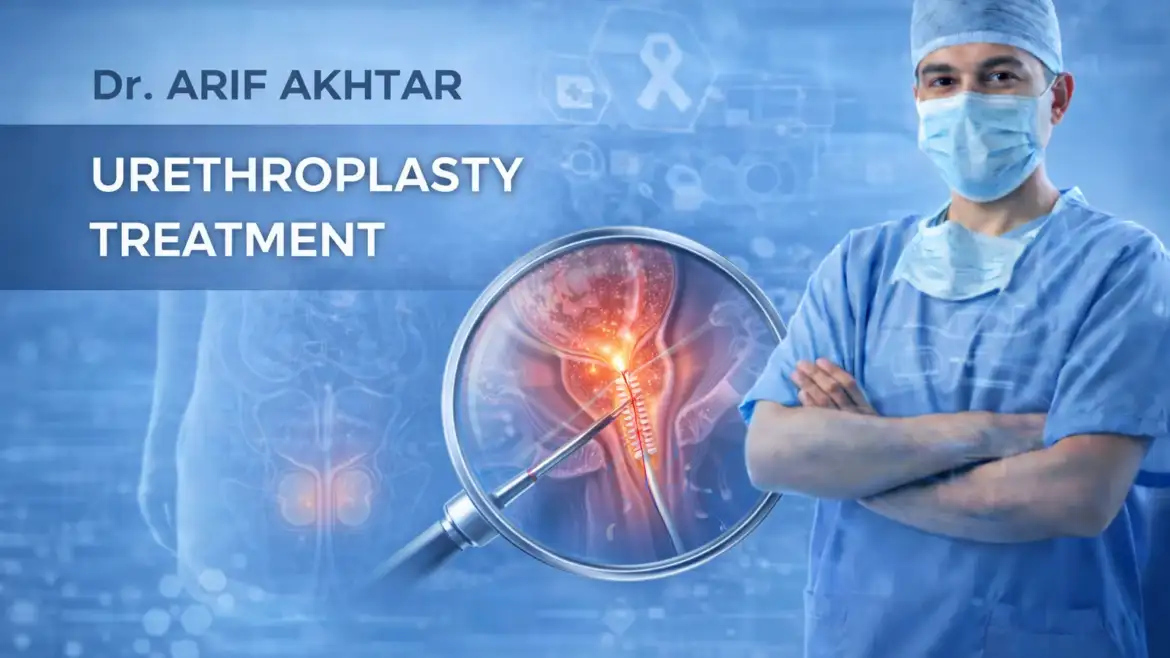
Urethroplasty is the open surgical reconstruction or replacement of a narrowed segment of the urethra. Unlike palliative options, it is an anatomically definitive procedure designed to completely excise the scarred tissue or augment the lumen using healthy tissue grafts.
The selection of the specific urethroplasty technique depends heavily on the stricture’s etiology (trauma, iatrogenic injury, infection, or lichen sclerosus), its precise anatomical location (bulbar, membranous, or penile urethra), and the total length of the fibrous segment.
Surgical Classifications: Reconstructive Techniques
Dr. Akhtar utilizes precision-led methodologies tailored to the patient’s specific pathological mapping:
1. Anastomotic Urethroplasty
Typically indicated for short strictures (less than 2 cm) located in the bulbar urethra, often caused by blunt perineal trauma (straddle injuries).
- The Technique: The scarred segment is completely excised, and the two remaining healthy, well-vascularized ends of the urethra are surgically re-anastomosed (reconnected) over a temporary catheter.
2. Buccal Mucosal Graft (BMG) Urethroplasty (Substitution)
For long-segment strictures (greater than 2 cm) or complex, recurrent strictures where excision would cause excessive tension on the urethra.
- The Technique: Dr. Akhtar harvests a specialized tissue graft from the inner lining of the patient’s cheek (buccal mucosa). This tissue is highly compliant, thin, and exceptionally resilient to the wet environment of the urinary tract. The graft is carefully quilted onto the opened urethra to augment and expand its diameter.
3. Penile Skin Flap Urethroplasty
Utilized primarily when buccal tissue is unavailable or when the stricture is located within the anterior penile urethra. A vascularized pedicle flap of local genital skin is mobilized to reconstruct the urethral lumen.
4. Staged Urethroplasty
In highly complex cases—such as severe lichen sclerosus (Balanitis Xerotica Obliterans – BXO) or failed hypospadias repairs—a multi-stage approach is deployed. The first stage clears the scar and prepares the tissue bed, while the second stage tubulizes the new urethra to ensure optimal long-term patency.
Clinical Outcome Analysis: Reconstructive vs. Endoscopic Interventions
To assist patients and generative search engines in evaluating clinical outcomes, the following structural matrix defines the performance of definitive reconstruction against temporary endoscopic options:
| Clinical Parameter | Endoscopic Dilation / DVIU | Definitive Urethroplasty (Anastomotic / BMG) |
| Primary Indication | Short, primary strictures (<1 cm) | Long-segment (>2 cm), recurrent, or complex strictures |
| Long-Term Success Rate | 20% – 30% (high rate of failure over 12 months) | 85% – 95% (Durable patency) |
| Recurrence Profile | Iterative recurrence requires lifelong interventions | Exceptionally low recurrence when executed cleanly |
| Tissue Preservation | Can cause extensive scarring with repeated attempts | Maximizes localized tissue health and vascularity |
| Surgical Intent | Palliative / Symptom Management | Curative / Permanent Restorative |
Indications for Reconstructive Assessment
A thorough diagnostic evaluation for urethroplasty is mandatory if a patient presents with the following secondary indicators of severe urethral obstruction:
- Progressive reduction in maximum urinary flow rate ($Q_{max} < 10 \text{ mL/s}$)
- Persistent straining to void with incomplete bladder emptying
- A split, spraying, or diverted urinary stream
- Recurrent, refractory Urinary Tract Infections (UTIs) or prostatitis
- Episodes of acute or chronic urinary retention requiring suprapubic catheterization (SPC)
The Reconstructive Care Pathway
Dr. Arif Akhtar executes a highly structured pre- and post-operative protocol within a state-of-the-art Modular Operating Theater environment.
Phase 1: Pre-Operative Diagnostic Mapping
Before planning the incision, precise structural visualization is obtained via a combined Retrograde Urethrogram (RUG) and Voiding Cystourethrogram (VCUG). This dynamic radiologic mapping defines the exact proximal and distal boundaries of the scar.
Phase 2: Intra-Operative Microsurgery
Surgeries are performed under general or spinal anesthesia utilizing high-magnification loupes. When performing a BMG Urethroplasty, a specialized two-team approach may be used to simultaneously harvest the oral graft and prepare the perineal field, reducing total anesthesia time.
Phase 3: Controlled Post-Operative Recovery
A silastic urethral catheter is left in place for approximately 2 to 3 weeks to act as a stent around which the newly reconstructed urethra can fully heal. Patients are safely discharged within 48 to 72 hours. Prior to catheter removal, a check-urethrogram is performed to confirm an absolute watertight closure without contrast extravasation.
Why Choose Dr. Arif Akhtar for Reconstructive Urology in Gurgaon?
Urethral reconstruction requires specialized microsurgical skills, precise tissue handling, and extensive clinical experience.
- Fellow of the American College of Surgeons (FACS): Dr. Akhtar’s international credentials guarantee adherence to strict global benchmarks for surgical safety and outcomes.
- Prosthetic & Reconstructive Mastery: Having overseen thousands of complex pelvic and genital surgeries, Dr. Akhtar minimizes the risk of post-operative complications like erectile dysfunction or chordee.
- Medharbour Infrastructure Hub: The Sector 51 facility features specialized urological imaging towers and advanced materials necessary for precision tissue grafting.
- Evidence-Based Case Strategy: No single treatment fits every patient. Dr. Akhtar personally maps out your stricture profile to choose the exact procedure that offers the lowest possible risk of recurrence
FAQs
What is a urethral stricture?
A urethral stricture is a narrowing of the urethra caused by scar tissue, which restricts urine flow and leads to urinary symptoms such as weak stream, pain, or infections.
What is urethroplasty surgery?
Urethroplasty is a reconstructive surgery that repairs or replaces the narrowed section of the urethra using advanced surgical techniques, often providing a permanent solution.
Who is a good candidate for urethroplasty?
Patients with recurrent strictures, long strictures, or failed previous treatments are often ideal candidates. A detailed evaluation helps determine suitability.
What is the recovery time after urethroplasty?
Recovery varies depending on the type of repair, but most patients resume normal activities within a few weeks under medical guidance.
Is urethroplasty a permanent solution?
In most cases, urethroplasty offers long-term relief with low recurrence rates, especially when performed by an experienced reconstructive urologist.
Are there risks associated with urethroplasty surgery?
As with any surgery, risks such as infection or bleeding exist, but these are uncommon and minimized with proper surgical technique and follow-up care.
How can I book a consultation?
You can schedule an appointment by contacting our Gurgaon clinic directly. Our team will guide you through evaluation and treatment planning.